The Stablecoin Adoption Trade
Stablecoins are undergoing a Cambrian explosion. From capital to policy to sentiment to participation, the stars have aligned like never before. In 2024, stablecoins moved $32.8tn in value and now move more money every day than Visa and Mastercard combined. In fact, stablecoins have become the dominant product in crypto. In 2020, they made up 3% of on chain transactions. Today, they account for more than half. Tether's USDT alone has been used by over 400 million users, comparable to that of PayPal.
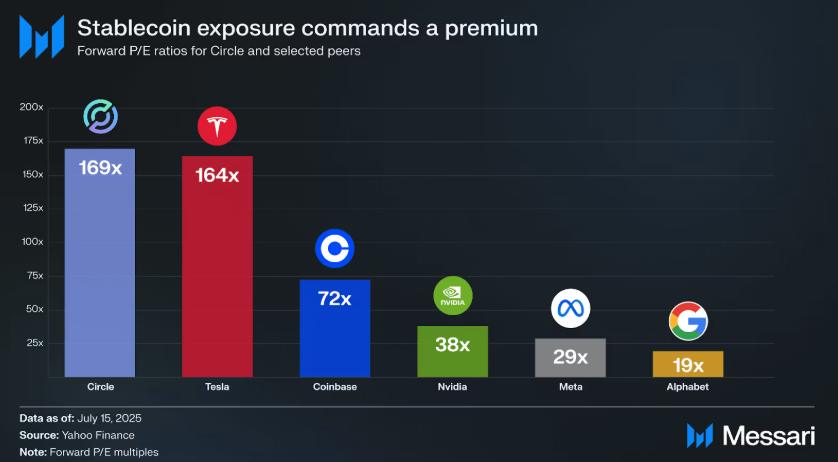
Meanwhile, legacy institutions, seeing this explosive growth, are stumbling head over tail to integrate stablecoins. Just in 2025 alone, Stripe acquired Bridge, a stablecoin infrastructure and API platform, for $1.1bn and Privy, an institutional-grade wallet service, for an undisclosed fee. BlackRock, Van Eck and Apollo launched their tokenized MMFs with settlement into stablecoins. Circle went public, becoming the best performing IPO of the year so far, trading at 169x P/E compared to 72x Coinbase and 38x Nvidia. The demand for market exposure to stablecoins is clear.
Institutional interest is not unfounded. Stablecoins improve on legacy systems in a number of ways and open up new and original use cases. SWIFT, the payment rail underpinning the whole of traditional finance, is vastly outdated, offering minimal transparency and up to T+1/2 settlement times in some cases. In contrast, stablecoins are fit for the ever-evolving digital age, offering near-instant settlement within seconds globally.
Moreover, stablecoins operate round the clock all year round and eliminate intermediaries (correspondent banks), drastically reducing transaction fees for cross-border payments, FX and institutional finance more broadly. Most significantly, stablecoins serve as the foundational settlement layer for the growing tokenization of real-world assets like equities, real estate and access to yield. Instant T+0 settlement is a huge unlock for the velocity of money, lifting the limiting factor on balance sheets (how quickly businesses can reuse their capital for transactions).
However, interest in stablecoins is not limited only to institutions. The passing of the GENIUS Act, which provided regulatory clarity requiring stablecoins to be fully backed by High Quality Liquid Assets (HQLA) and subject to regular audits, is essentially the green light from the U.S. Government, and the final piece in the puzzle for stablecoin adoption.
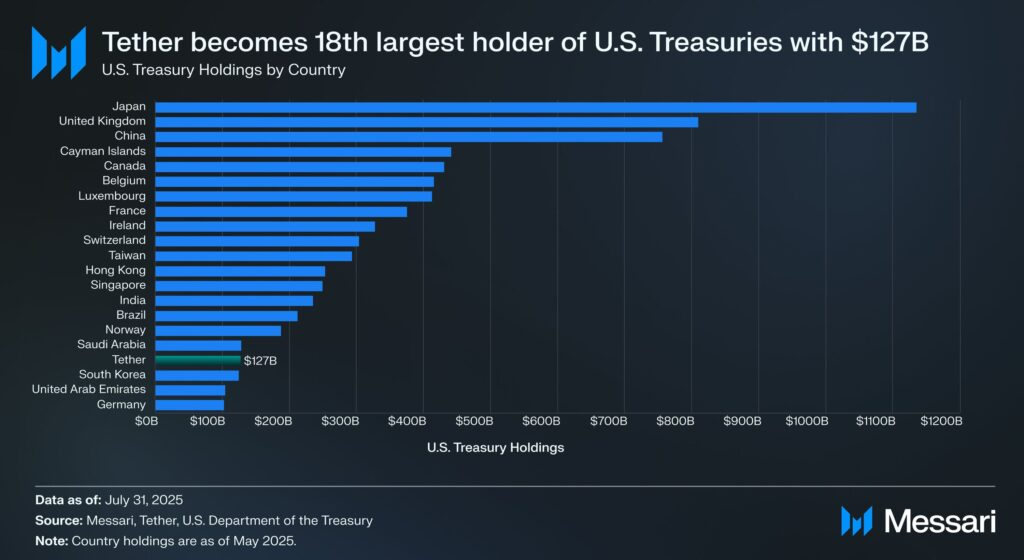
But why would the US champion stablecoins? The answer is two fold. With US government debt increasing exponentially, and $9.2tn in U.S. Treasuries maturing this year, Trump is seeking ways to roll this debt over cheaply. Tether is the 18th largest holder of U.S Treasuries, ahead of countries such as Germany, the UAE and South Korea. The GENIUS Act's HQLA requirement enforces a new source of latent demand for government bonds by law, thus lowering rates and allowing Trump to roll over the debt more cheaply.
Also, by championing Dollar stablecoins in an emerging technology that could underpin the entire financial system in the future, the US is able to better maintain the US Hegemony globally. By making dollar-denominated assets accessible to anyone with an internet connection, stablecoins essentially "export" the Dollar as the default digital currency for the world. Approximately 99% of stablecoins are currently dollar-backed stablecoins, a statistic that the U.S. will wish to maintain. In this way, stablecoins are not only game-changing for financial institutions from a technological perspective, but they have also become a geopolitical tool for the most powerful nation in the world.
The market cap of stablecoins currently sits at $280bn, per DefiLlama. Given the aforementioned bullish tailwinds, this appears pretty low for a technology that not only has the potential to revolutionize the entire financial industry, but also is being intentionally weaponised by the US Government. To be clear, 2025 has been touted as the year of stablecoins, but the GENIUS Act is the start of something far bigger. Standard Chartered forecasts $400bn in issuance by year-end and $2tn by 2028. But where in the market offers the best upside to capitalise from this growth?
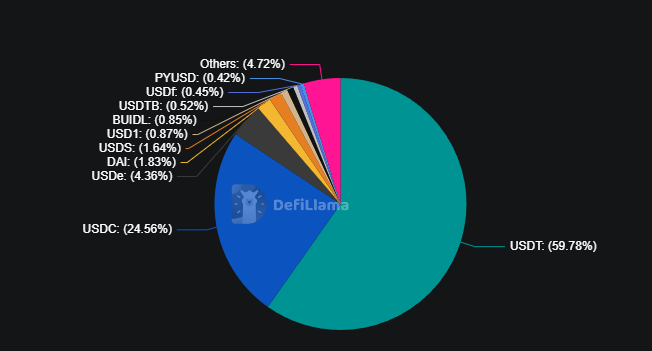
In order to analyse this, it is necessary to look at the current state of the sector. Tether dominates market share with around 60%, and USDC lags behind with around 25%.
Recently, PayPal has issued its own stablecoin (PYUSD). Stripe, following its acquisitions earlier in the year, has announced plans to build its own proprietary L1 and by extension, to launch its own stablecoins. Google is also planning to build its own L1. Tether is backing Plasma and Stable as Tether-denominated chains, while Circle is launching Arc as its own iteration. The race is on to capture value from the whole stack, from issuance to transaction and gas fees.
This raises several questions. Will stablecoins become commoditized (ie. will every company issue their own stablecoin)? Or will one prevail? Does Tether have a moat? Will stablecoins end up using these stablecoin specific L1s? Or will generalized L1s win? If we live in a world where there are hundreds of different 'dollar' stablecoins for each use-case/business, does the core principle of the singleness/fungibility of money even maintain?
Standout exposure opportunities
So what are the standout exposure opportunities? (Ranked by confidence)
- Anything related to Tether will fly. It is one of the most profitable companies in the world, now has deep ties to the White House by virtue of being one of the largest holders of US debt and is the category leader. If the Circle IPO succeeded, anything Tether adjacent will by an order of magnitude. Plasma's XPL token appears to be the only vehicle but is yet to launch, although if Stable decides to do a token this would be a good way to get exposure too.
- Frax CEO is now the CTO of Stable. Aiming to strengthen ties between Frax ecosystem and Tether eco? Could now be considered potential Tether exposure.
- ChainLink (recommend reading full thesis here, but TLDR below):
- When in a gold rush, sell shovels. Chainlink sets to benefit from stablecoins on multiple fronts.
- Immediate Profitability & Aligned Tokenomics: Chainlink is already a highly profitable "money-making machine," having earned hundreds of millions in fees. These past fees are now being used for $LINK token buybacks into a reserve, directly aligning the protocol's success with token holders and avoiding conflicts of interest seen with projects like Ripple.
- Proven Market Dominance & Adoption: Chainlink is the undisputed market leader, with its market share now higher than in 2021. It secures over $91B in DeFi value and commands a 68% market share across all blockchains (84% on Ethereum).
- Unmatched TradFi Integration: It is years ahead of any competitor in institutional adoption, with a vast network including SWIFT, DTCC, JP Morgan, UBS, Visa, and Mastercard. The Head of Strategy at SWIFT even stated they view Chainlink as having lower platform risk than any blockchain.
- A Complete, Defensible Platform: Chainlink's moat is its end-to-end platform. Competitors can't compete because they lack the full suite of services: data, interoperability (CCIP), privacy, and compliance (ACE). Institutions prefer this single, non-fragmented solution for all their on-chain needs.
- The Biggest Winner of RWA Tokenization: The thesis argues Chainlink will be the primary beneficiary of the GENIUS Act. Its compliance services (ACE) are natively embedded into the SEC-endorsed ERC3643 token standard, meaning institutions tokenizing assets will use Chainlink by default.
- Superior Value Accrual: Unlike L1s that only earn gas fees, Chainlink captures value directly proportional to the activity it enables. Through Smart Value Recapture (SVR/OEV), it will earn a percentage of DeFi liquidations on protocols like Aave, with all revenue flowing back into token buybacks.
- The "AWS of Web3" Valuation Thesis: The ultimate argument is that Chainlink is the foundational, "winner-take-all" B2B infrastructure for on-chain finance - the equivalent of AWS, Azure, and GCP combined (~$2T market cap). It is the true "rails" and has a far more direct and scalable value accrual model than L1 tokens, yet trades at a tiny fraction of the value it secures.
- Per my sub $500mm mcap report, $RED can be seen as a potential beta play to Link and will certainly gain some market share from Link in specific DeFi niches. However, looking at raw exposure to the stablecoin trade, few come close to the moat of LINK.
- Crime play: $WLFI
- USD1 (WLFI stable) backed by U.S Treasuries. Interest earned on USD1s reserves is routed automatically by smart contracts into buying and burning WLFI on the open market.
- Flow = Reserves -> Protocol income -> WLFI repurchase and burn -> Holder upside
- WLFI, governance token launching 1st Sept, 5% float at launch (20% of presale tokens tradable at launch)
- Donald, Eric, Barron and Jr Trump are all 'Co-founders'.
- DWF labs bought in at $0.10, Aqua One $100M at $0.125, ALT5 $1.5B at $0.2 for 7.5% supply. ALT5 also has $750M approved for WLFI purchases.
- Ponzinomics:
- With only 5% supply circulating at launch, at $20B val, only $1B worth of tradeable tokens. With $750M due to be bought, insiders could absorb entire float.
- Creates reflexive feedback loop: buying pressure lifts token, making insider locked allocations more valuable, strengthening balance sheet used to support the market.
- USD1 (WLFI stable) backed by U.S Treasuries. Interest earned on USD1s reserves is routed automatically by smart contracts into buying and burning WLFI on the open market.
- Yield adjacent trades:
- If the premise that Stablecoin TVL will rise is accepted, it follows that this TVL will want to access yield for the idle dollars. Yield bearing stablecoins themselves will see a huge uptick.
- Aave thesis:
- Aave is the biggest and most reputable lending/yield platform with the largest history. Institutions like trust based on historical performance.
- USDT on Aave hit an $8.1bn ATH on August 5th, and this number should scale with stablecoin TVL increase.
- Morpho:
- Same as above, except $700m mcap and with a Mcap/TVL ratio of 0.097 compared to Aave's 0.12, per data from DefiLlama
- Pendle:
- Pendle is the world's largest crypto yield trading platform. It allows anyone to lock in fixed yields on yield-bearing assets and has consistently proven innovation to DeFi.
- Pendle currently captures 30% of the yield-bearing stablecoin market, with over 80% of its $10.5bn TVL made up of stables.
- Yield bearing stablecoins themselves are only 4.5% of the market, with a TVL of $11bn.
- Unlike other DeFi yield platforms, Pendle acts as distributor/customer acquisition engine for its partners and therefore benefits institutions launching their own yield bearing stablecoins (see Hashnote USYC, Agant GBPY). Pendle therefore will have a share in both native DeFi yield growth and institutional yield growth. Over 40% of Ethena's total TVL can be attributed to Pendle. Spartan Group, in its thesis, argues that Ethena leveraged Pendle when USDe launched in Feb 2024, to bootstrap initial liquidity. In 4 months, Pendle enabled Ethena to scale from 0 to $3bn issuance.
- Pendle generates $35-40MM in annualized revenue, trading at a P/E ratio of around 16-20, relatively cheap for a protocol that acts as the leading proxy for stablecoin TVL, and by extension, yield TVL growth.
- Boros coming in will unlock additional upside from arbing perps funding rate (active yield trading).
- Pendle at current prices is ridiculously cheap. For deeper analysis into price forecasts, see here and here.
- Ethena:
- Will benefit from incoming stablecoin flow, as institutions become more curious about DeFi native yields. Essentially yield generated from basis, which is relatively familiar to legacy heads. It is therefore just far enough along the risk curve to be both interesting and not too risky for institutions.
- Private Rounds / Launching a product:
- Clearly, there is still plenty of upside in stablecoins. Highest upside may be in investing in early stage stablecoin infra or going hard building in specific infra niche. For example, Rain is building a blockchain-based card and interop platform, and just raised $58M Series B. Literally as I'm writing this, M0 announced $40M Series B. Quite clear this is where the capital allocation is taking place.
Risks
- Trump is clearly using stablecoins, as well as pressure on the FED, to lower the interest rate, allowing him to better roll over the US government debt. However, inflation concerns exist if Trump manages to force the FED to lower the rate, which will be good for crypto in the short term as liquidity spills into the market, but perhaps damaging to the economy in the longterm. However, stablecoins should be in Trump's longer term strategy to continue the US hegemony.
- Yield Compression: The entire thesis for yield-bearing stablecoins and protocols like Pendle is predicated on the existence of yield. If global central banks return to a Zero Interest Rate Policy (ZIRP) and DeFi yields compress due to market saturation or a prolonged bear market, the incentive to hold YBS evaporates. Why would users take on smart contract risk for a 0.5% yield when they can get that in a traditional, insured bank account? This would cripple demand and destroy the business model of yield-trading platforms.
- CBDCs?
References
- x.com/0xkyle\_\_ (1955309801338180014)
- x.com/0xkyle\_\_ (1931912301600518313)
- x.com/CampbellJAustin (1955237754859618618)
- x.com/CatfishFishy (1955231285397389368)
- x.com/CatfishFishy (1955394912926470242)
- Goldman Sachs — Stablecoin Summer
- Visa Onchain Analytics
- defillama.com
- Plasma raises $373 million in token sale
- Fireblocks — The Velocity of Money
- Yield-bearing stablecoins hit $11b, Pendle dominates growth
- Spartan Group — Pendle: The Era of Stablecoin Expansion
- x.com/GLC\_Research (1933145236949094557)