Research Coin Thesis
Introduction
When people hear the word 'crypto', they picture elaborate ponzi schemes, underground dark-web money laundering and obscure dog coins momentarily becoming the new medium of financial exchange. But what if crypto as a technology could enable serious societal change? As the industry continues to push innovation forward, many applications for blockchain and cryptographic technology have been unveiled, in sectors such as AI, Real-World-Assets and Science. Yep, you heard that correctly, blockchain is now disrupting science. How (you may reasonably ask)? Well, let's dive in.
Background
For many years, science was a meritocratic realm of academia. Whether it was Newton observing apples falling off a tree and discovering gravity or Aristarchus in 300BC estimating the distance between the earth and the moon almost perfectly, science has always rewarded those who have dared to think hard. However, the modern scientific model has strayed far from its roots. Riddled with corruption, oligopolistic and …, one's success as a scientist now relies not on the quality of research but rather on 'popularity' and 'reputation'.
The problems with modern science are plentiful. Perhaps the most pressing issue at the heart of the problem of modern science is funding. Simply put, for scientists to produce research, they need money – and usually quite a lot of it. Average grant sizes from the NIH (National Institute of Health) have been rising steadily over the last decade, and current average grant sizes sit at over $600,000 per proposal (here). It can often take a researcher 3-5 years to go through the process of applying for funding, completing the research, submitting a paper to journals, having it reviewed and finally getting published. According to Rouse (2016), U.S university faculty members spend "40% of their research time navigating the bureaucratic labyrinth, and the situation is no better in Europe". To make matters worse, many experts believe that securing research funding is an often biased and inefficient process within the existing system (here, Murrey et al., 2016; Krimsky, 2013; Lariviere, 2018). It was found that, especially when funded by for-profit organizations, scientists tended to skew their results to support the interests of their funding source (here).
Moreover, the likelihood of receiving funding is closely tied to a reputation system called the 'h-index', which is depended on by all scientific institutions to gauge 'impact'. This sadly incentivises researchers to publish a high volume of papers – a 'publish or perish' mentality, if you will – rather than focusing on the quality of their work, further distracting scientists from realising potentially ground-breaking discoveries.
Many of the world's successful scientific papers flow through one of the big three scientific journals: Science Magazine, Nature or PNAS (Proceedings of the National Academy of Sciences). While on the surface they appear to celebrate new and world-changing discoveries, the monopoly they have on the publishing game tells another story. Indeed, according to a study by WIPO, 53.6% of articles flowed through the top five publishers in 2020. This centralisation essentially puts the decision of what to publish in the hands of the profit-driven CEOs of these journals, who make money from showcasing these novel breakthroughs and garnering more subscriptions as opposed to potentially more important but less flashy research. In fact, Nature also charge the scientists themselves, reportedly over $11,000 per paper in some cases. As a result of the above, scientific data is gatekept under paywall and kept in disjointed databases across multiple journals, keeping scientists with fewer resources away from important information needed to run other studies (Nagaraj, et. Al, 2020).
So how do we solve this? Efforts have been made by initiatives/movements such as Open Science to improve the status quo, but many believe it has fallen short of expectations (Bankless). With big conglomerates such as Nature controlling who and what gets published, it is clear to see that the existing model of science relies on centralisation. This is where DeSci (Decentralised Science) comes in.
Decentralised Science, empowered by the permissionless nature of blockchain technology, is a movement designed to increase scientific funding, eliminate reliance on profit-hungry intermediaries and increase collaboration across the field. At the core of DeSci are DAOs (Decentralised Autonomous Organisations), which essentially act as independent communities, often with quite sizeable treasuries, that work towards fulfilling their communal goal. They often target specific aspects of scientific research, such as funding, peer review, incentives and access. For example, VitaDAO is dedicated to funding and advancing early stage longevity research, while PsyDAO channels funds into unlocking the power of psychedelics as a viable remedy for mental health issues.
Because blockchain technology allows for permissionless ownership (in the sense that it, at its core, is a string of transactions that are verified, through the use of an extremely sophisticated cryptographic algorithm, by many different 'miners'/participants across the globe), it has the potential to revolutionise science in many ways. Scientists will have rightful ownership of their own intellectual property, as opposed to greedy universities that take claim for research in return for (again) funding, salary and recognition. Data will be published to the decentralised ledger and will therefore be open for everyone to access, incentivising good and honest practices away from the skewed motives sometimes brought about by private funding.
In fact, blockchain also creates the possibility of alternative, more fair funding models such as quadratic funding, deemed by Gitcoin as the "mathematically optimal way to fund an ecosystem democratically" (here). Quadratic funding is essentially a crowd-funding mechanism that amplifies available resources by inviting community members to make donations (big or small) that act as votes on where to allocate funds, as described by wtfisquadraticfunding.
Decentralised Science is still very much in its infancy and it is certain that many of the main applications have not yet been built yet, but what is currently available on the market is extremely promising. Another application of blockchain is tokenisation and its financial incentives. Which leads me on to the topic of this thesis: ResearchCoin.
ResearchCoin, ResearchHub, How About You Research a Girlfriend?
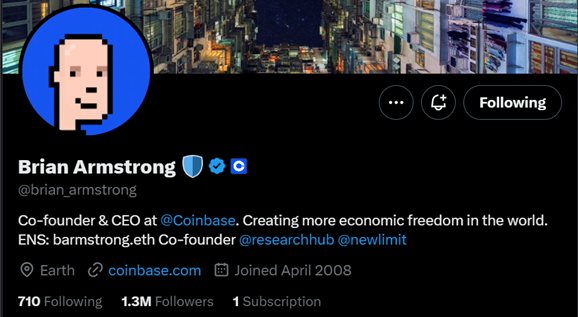
Let me present to you ResearchCoin… or ResearchHub, as the site is called. Founded by Brian Armstrong, the CEO and founder of Coinbase, its mission is to accelerate scientific research by creating a platform upon which scientists can collaborate on research in a much more efficient way, similar to what GitHub has done for software engineering (here).
Researchers can upload articles in PDF form, summarise the findings of the work in an attached wiki, and discuss the findings in a completely open and accessible forum dedicated solely to the relevant article (here).
The idea was sparked by a blogpost created by Armstrong (here) in 2019, in which he laid out in detail the problem with current science as well as his proposed solutions. Among his numerous suggestions is the proposal to break away from scientific papers as an 'end result' and instead have collaboration throughout the process, for example if a science were to merely suggest a "hypothesis (something you'd like to see tested in the future), or a provide a dataset (that you weren't able to draw any conclusions from)".
Where does ResearchCoin come in?
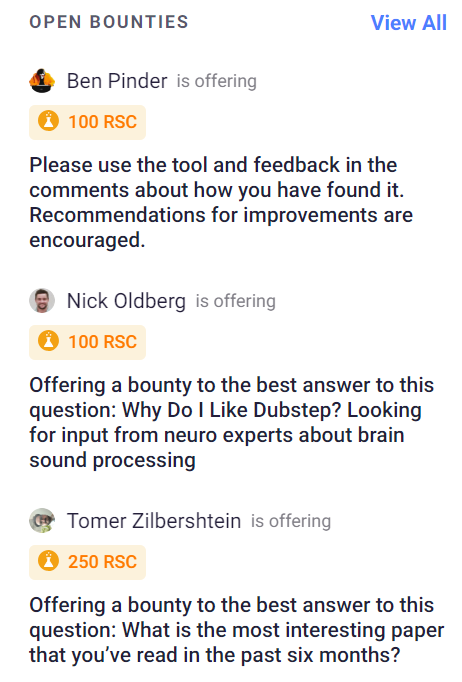
Integral to what ResearchHub has built is ResearchCoin (RSC), the token native to the platform. Users can earn RSC by sharing, curating and discussing topics within the platform, and even set bounties for questions they want answering or papers they want peer-reviewing (e.g a user created a bounty of 350 RSC or $140 at current prices for someone to recommend them an AI tool to help them analyse biological samples for their PhD). Indeed, in a similar way to Reddit Karma, you can tip people with RSC if they have made a particularly impressive contribution.
This kind of incentive-based tokenization system is not particularly new within crypto (native tokens are used as incentives on exchanges such as Binance, for example, where users can hold BNB in their wallet and receive reduced fees on selected markets), but is certainly a use-case that can be leveraged more efficiently to make existing systems more efficient (e.g making the real estate market more liquid).
$RSC Tokenomics
So far so good, right? Well, to really get an understanding of the value of RSC, we need to look at how the token is distributed. There is a total of 1 billion ResearchCoin in existence, with following allocations:
- 60% allocated to the community and users of ResearchHub
- 20% retained by ResearchHub Technologies, Inc.
- 10% for ResearchHub's founders
- 10% reserved for paying future ResearchHub employees with equity.
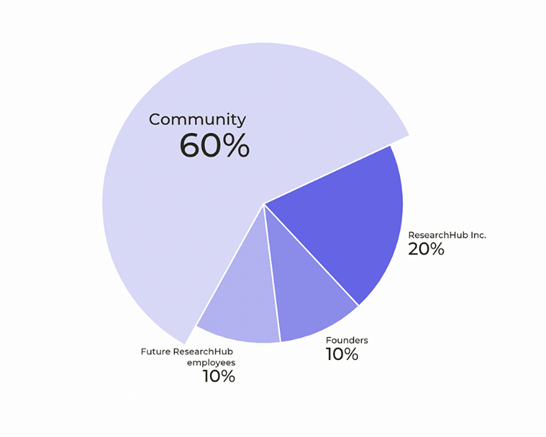
As token distributions in crypto go, a 60% allocation for the community is pretty generous – if we take Wormhole ($W), the most recent airdrop as of the time of writing, the community allocation lies at a measly 17% (here), while Jupiter, lauded by many as having excellent tokenomics, has handed over 50% to the community.
Like many token offerings, RSC is subject to a vesting and emission schedule. The team opted to emit tokens over a 12 year time horizon, incentivising the nurturing of a healthy community of contributors. Tokens are released on a per annum basis that is subject to change depending on how the community decides to vote on it (for example, the current emission rate for the community is 5% per year)

Hubs
In order to create a decentralised version of Github for science, it is essential to address the problem of large, centralised publishers which have a chokehold on the scientific world. In lieu of this issue, ResearchHub has created 'Hubs', which are individual forums addressing a specific area of science. For example, there are hubs for chemistry, physics, computer science, machine learning, psychology and so on. They allow for streamlined and open publishing of scientific or academic content directly into these hubs, which removes the gatekeeping process of traditional publishing and allows information dissemination to be accelerated and then peer reviewed post-publication (here).
Investment Thesis
To preface this, I want to highlight a particular heuristic echoed by many of the world's leading investors.
The consensus is often wrong, so I have to be an independent thinker. To make any money you have to be right when they're wrong. – Ray Dalio
You make the most money when you are early to a brilliant idea before everyone else thinks it's brilliant. Investing early on into Facebook comes to mind - imagine realising the potential of connecting many people over the internet in one place. Another one is Uber, and another one is Bitcoin. And I believe there is strong evidence to believe that we have a brilliant idea on our hands here, or at least one that is being very much overlooked by the wider market.
The investment thesis for RSC can be expressed very simply as the following: coin created by the most successful founder in crypto with multiple bullish catalysts coming up as well as a functional product with a large amount of already-acquired users sitting at a criminally low market cap in a sector yet to be properly discovered by the rest of the market. Now, if that didn't make much sense, let's break it down in more detail.
First of all, from a top-down perspective, let's evaluate the extent to which the DeSci sector is an attractive investment. According to CoinMarketCap at the time of writing, the market cap of the entire sector lies at a mere $800m. To put this in perspective, $WIF, the meme coin of the moment, has a market cap of over $3bn and the AI sector currently sits at almost $20bn. But, in the attention economy and with AI all the rage, why would anyone really be looking at DeSci?
Well, humans are predicted to make significant advances in the realms of biotechnology in the 21st Century (here01394-3)). Indeed, if, as Yuval Noah Harari puts it in his book Homo Sapiens, humans are able to solve 'old age and death as technical problems' (here) and achieve longevity, then there is much opportunity investing in such a potentially life-changing (and indeed life-lengthening) technology. Achieving longevity isn't some sort of pipe-dream – people are working on this problem right now. Bill Gates (here), Peter Thiel (here) and Brian Armstrong, who, alongside ResearchHub and Coinbase, has started his own longevity business called NewLimit (here), are all deeply involved.
There is therefore reason to believe that DeSci as a sector, sitting at a cumulative market cap ~1/20th the size of that of Artificial Intelligence, is ripe for upside.
The fact that Armstrong first founded ResearchHub and then NewLimit highlights the opportunity here – in order to reach longevity, or indeed any other homo-sapien altering breakthrough such as ASI (Artificial Super Intelligence), more quickly and efficiently, science needs to change. And DeSci is the answer.
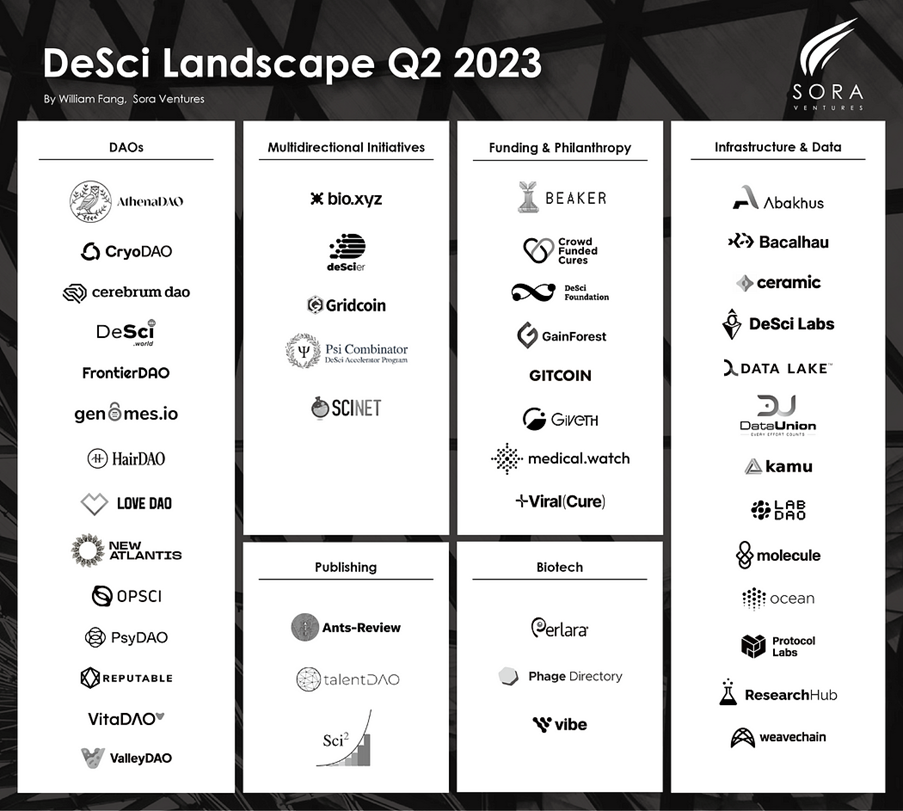
Within DeSci, then, how does ResearchHub fit in? Current notable projects include molecule (here), which "is a protocol, marketplace and service provider to the DeSci community" (here) and has set up an incubating program for budding DeSci projects/founders seeking funding. It has funded the largest DAOs (Decentralised Autonomous Organisations) in the sector, namely VitaDAO, which focuses specifically on longevity research, PsyDAO, furthering research into psychedelic medicine, and CryoDAO, pushing forward the field of cryopreservation.
The sector is certainly very young, with over 50% of the projects being built in the past year alone (here). Yet, ResearchHub, with its established user base of over 40,000, extremely active discussion forums and prestigious team, seems to stand out.
Macro Analysis
The entire crypto market, aside from a few rare price dislocations (e.g see $RLB's monster bear market rally from July to November 2023), moves in tandem with Bitcoin. When Bitcoin does well, the whole crypto market will too, and the rotation game within crypto will commence wherein the hot ball of liquidity flows from narrative to narrative, generating obscene amounts of wealth for the well positioned, until Bitcoin tops. When Bitcoin does badly, the entire market nukes and remains muted until Bitcoin goes up again.
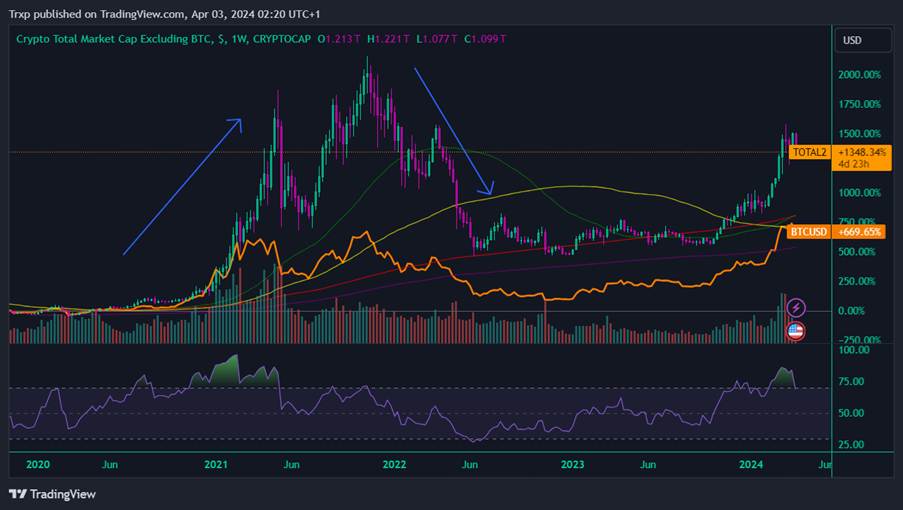
So, what do the conditions look like for Bitcoin to succeed in the future? Looking at the long term first, the thesis for Bitcoin is simple. World government debt has never been higher. Governments can print money and issue debt at their will. Populations, in countries such as South Korea and Japan, are facing grave depopulation issues. Global instability, with major wars in Ukraine and Russia and Israel and Palestine, is on the rise. The world is becoming increasingly digital and Bitcoin, with a hard supply cap of 21 million bitcoins and fully decentralised, is hard digital money. The thesis for Bitcoin is the same as the thesis for Gold.
Hard assets are and always will be hedges against fiat currency by nature of their inherent value. De-dollarisation is nothing new, and the short USD long BTC thesis has been speculated upon by names such as Ray Dalio in his book The New World Order, as well as more recently Blackrock CEO Larry Fink (here). Bitcoin at the same market cap as gold puts the price at $600,000 per Bitcoin, a 9.2x away at current prices, and therein lies the opportunity.
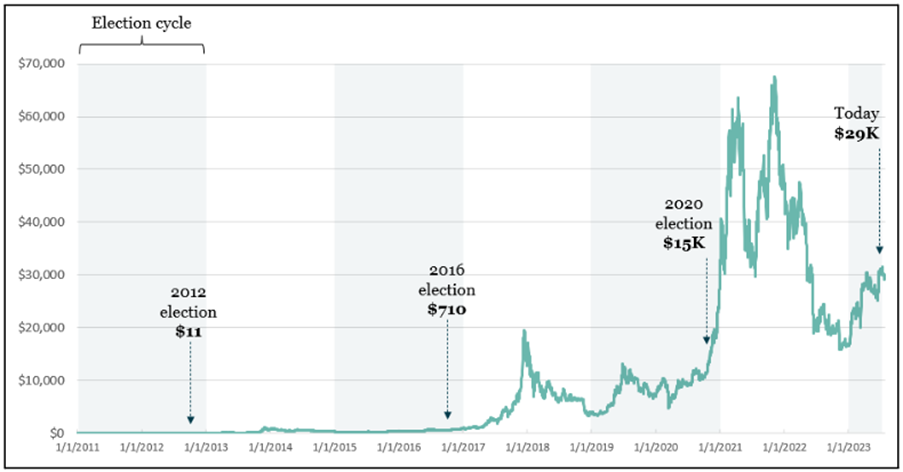
In the short term, say 1-3 years, the macro headwinds are strong. The launch of the recent BTC ETF by names such as Blackrock, Fidelity and VanEck indicate the level of institutional interest in digital assets. Crypto is slowly becoming more accepted by more serious players, and with ETH ETFs already on the horizon (here), this progress shows no sign of stopping. 2024 is also election year and historically elections are positive for markets, as the current president lowers interest rates in order to stimulate economic growth in an attempt to brag about the success of their term and achieve re-election.
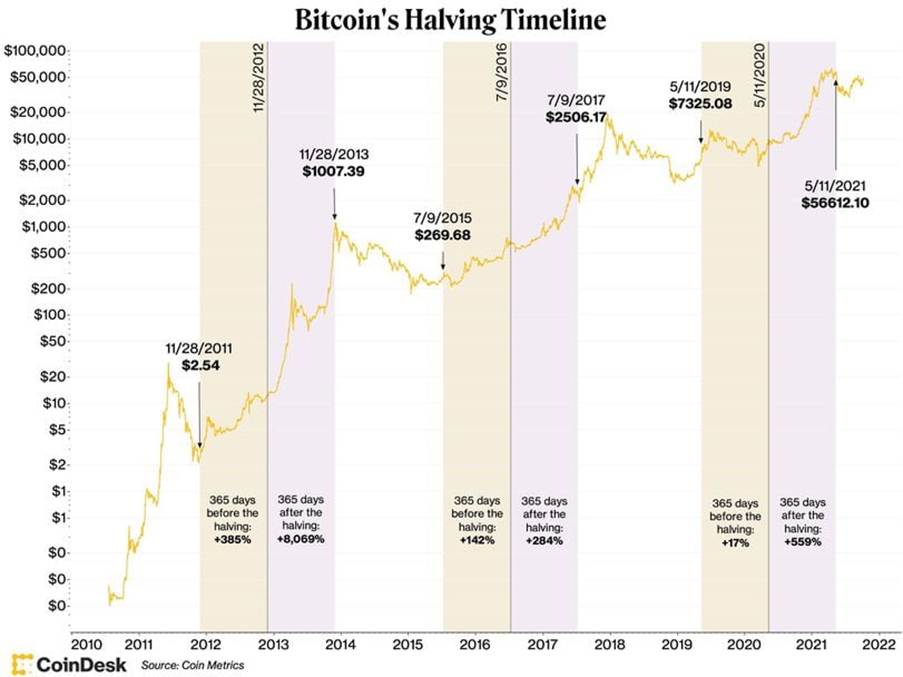
Within crypto then, what do the catalysts look like? The Bitcoin halving happens on 20th April, in which the block reward handed out for successfully mining a block halves (as an inherent hedge against inflation), which has historically preceded appreciation in price.
Additionally, the Bitcoin MVRV chart, which compares the current market value (MV) of bitcoin (price\total supply = MV) to the realized market value (RV) (the sumproduct of price\ unit supply at the time each unit last moved onchain = RV). A ratio under 1 is golden. A ratio over 3 has always marked a cycle top (here). Sitting at a current MVRV score of 1.7, the current bull cycle is well under way, but has yet to reach its ignition stage. To compare with last cycle, Bitcoin sat at a price of $16k when the MVRV score was at 1.7, and went on to 4.3x from there before reaching a MVRV score of 3+, while the entire crypto market added $2tn+ worth of value.
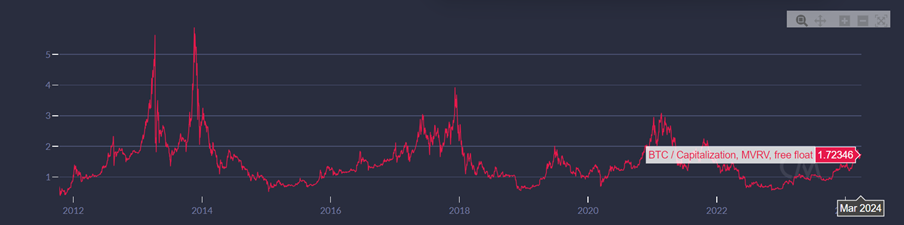
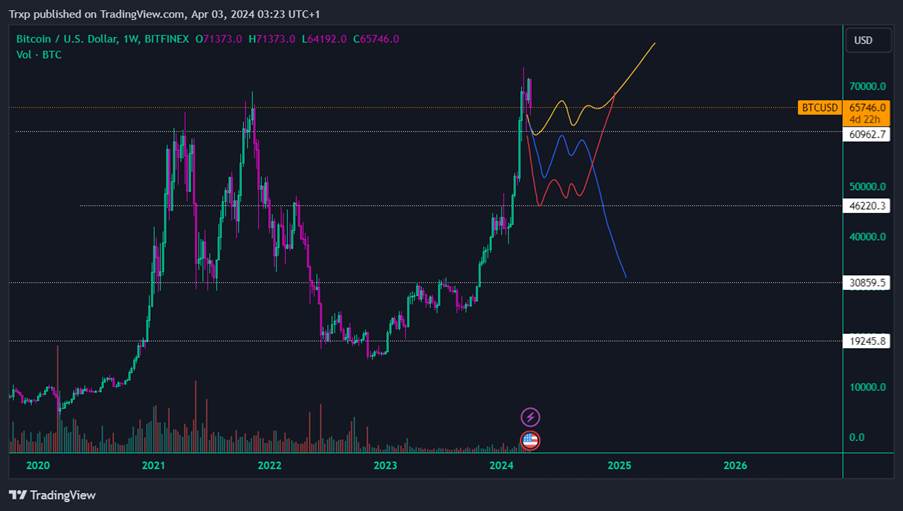
It is clear then that Bitcoin, and by extension the wider crypto market, is experiencing prime conditions for growth. However, it must also be noted that Bitcoin has increased almost 300% in the last year and therefore caution must be taken, especially given that we are hovering around all-time-highs. A clean break above said highs, followed by follow through with momentum, would indicate full risk-on.
Token sales and DAOs were built to revolutionize how we do research, and there is enough interest in longevity, rare disease treatments, and space exploration alone to drive development in this sector. – Messari Crypto Thesis 2024