High on Supply
Valuations in crypto are due for a rapid rerating. For over a decade, these stratospheric prices have baffled traditional investors, largely to the amusement of crypto natives. Bitcoin, the original cryptocurrency pioneered by the infamous Satoshi Nakamoto, hit an all-time peak valuation of $2.5 Trillion in October of 2025, while Ethereum, which introduced the smart contract layer on top of fundamental blockchain tech, topped out at around $580 Billion. Now, both Bitcoin and Ethereum are on the one hand useful, and on the other hand iconic. While one could argue that Bitcoin has not fulfilled its vision as 'Electronic Cash', in part due to its volatility, it is certainly the purest memetic representation of the libertarian values of the crypto movement - and there is definitely value in that. The extent to which Bitcoin itself is useful is not within the scope of this essay, but I would posit that its current core utility lies in the ease at which it enables cross-border money movement in times of crisis (as opposed, say, to gold bars).
However, having 'utility' is not, in fact, a necessary condition for a cryptocurrency to command a stratospheric valuation. Take Dogecoin, a tokenized representation of a shiba-inu dog, which peaked at a whopping ~$90 Billion valuation in 2021. Read that again. 90 Billion United States Dollars of pure thin air, otherwise known as 'memetic strength', or colloquially as 'it's just a meme bro, it's not that serious'.
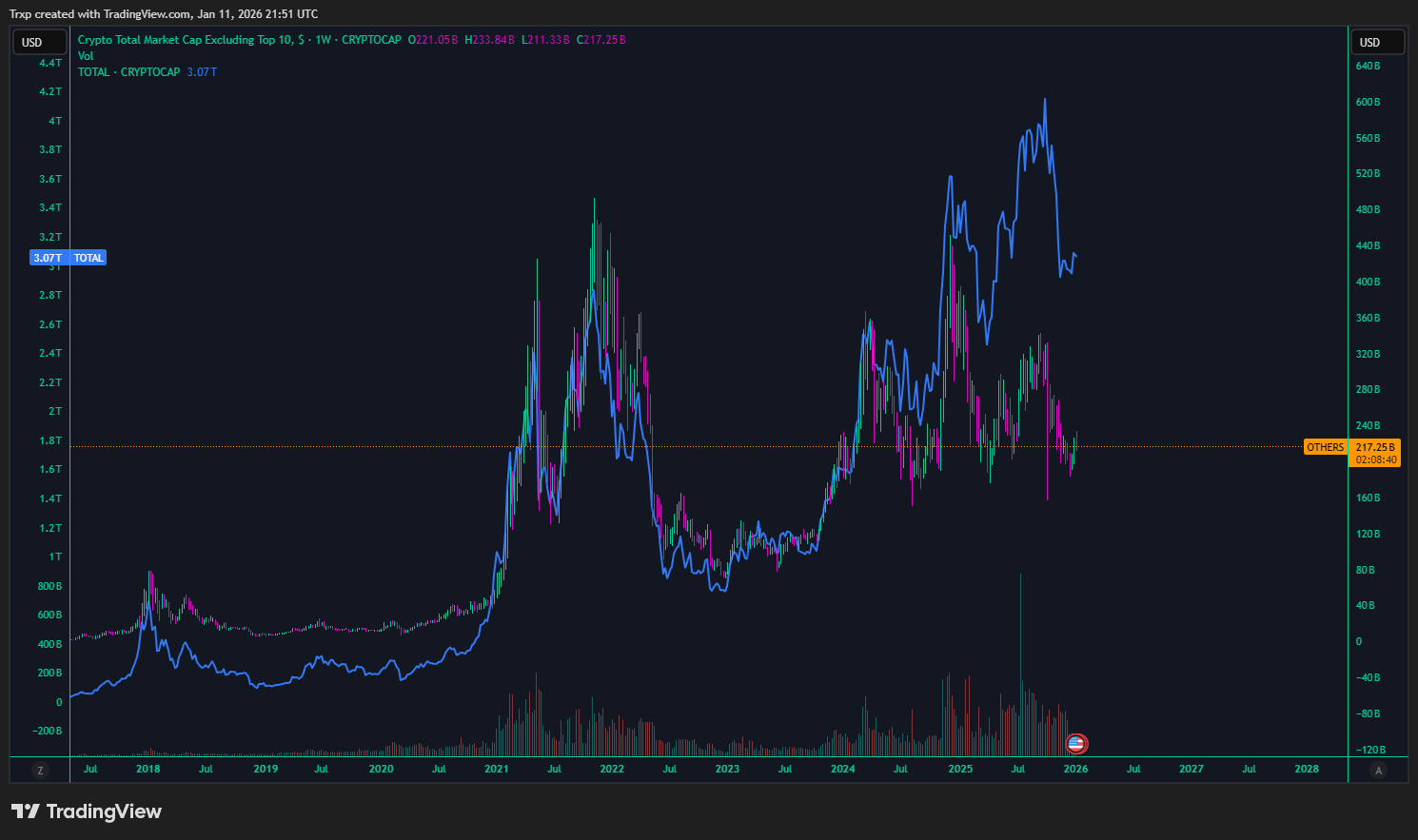
In recent years, though, 'altcoins' have struggled to keep pace with 'majors' (the top 10 coins). The chart below shows OTHERS (crypto market cap without the top 10 coins, in candlesticks) against TOTAL (the total crypto market cap, in blue). You can see that in 2021 and prior, they traded in tandem. However, in 2025, OTHERS lagged behind, while TOTAL made higher highs, expressing the divergence in returns between the top 10 coins and the rest of the playing field. But why is this the case? And what is in store for valuations in light of these shifts?
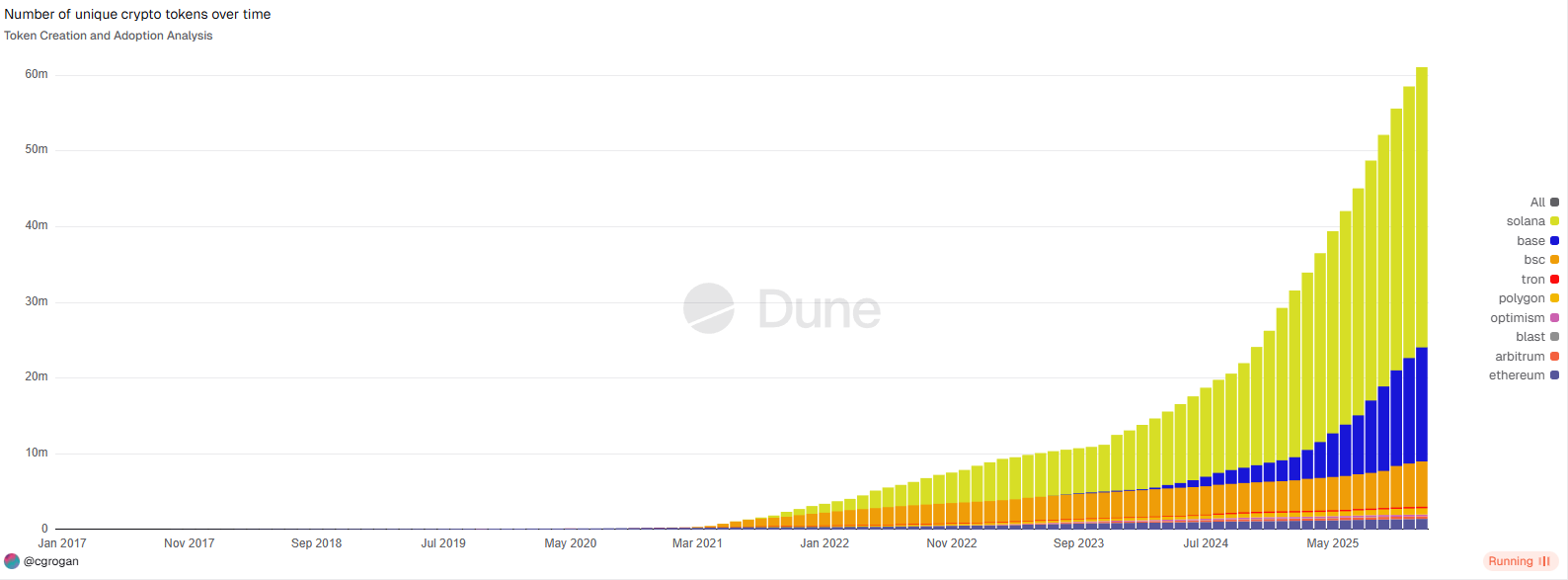
One solid reason here has been an exponential increase in the number of tokens (as shown in the graph below). As demand has stabilised (or indeed declined), the obvious massive uptick in unique token supply has not proven particularly positive for broader altcoin returns, and indeed returns have tended to be concentrated, rather than evenly distributed. In other words, a small number of tokens perform well, while the vast majority bleed out.
This supply overhang has underpinned a key mental framework shift. When technological revolutions occur, often paired with financial bubbles, it is common for investors and speculators to price the societal impact of said technology according to far too short a timeframe. For example, in the dotcom bubble of the late 90s, internet firms were reaching valuations in the hundreds of billions, without much real-world impact to justify these valuations. Similarly, a decade ago, when blockchain technology was still very much nascent and had grand promises to revolutionise the entirety of global finance, investors and speculators had only a few hundred tokens to express a bullish view on. This naturally led to exorbitant valuations, reflecting the human tendency to overestimate the effect of technology in the short run and underestimate its effect in the long run, a phenomenon known as Amara's Law, coined by Roy Amara in the 1960s.
A decade on, expectations for blockchain technology are becoming more in line with reality. Investors are increasingly looking at fundamentals - revenue, users, growth rate - to determine whether a token may be a good investment, rather than mere narrative. While narrative valuations were based on the potential of future fundamentals, as time has gone on, and 'future' fundamentals have failed to realize, valuations have decreased and narratives have less potency.
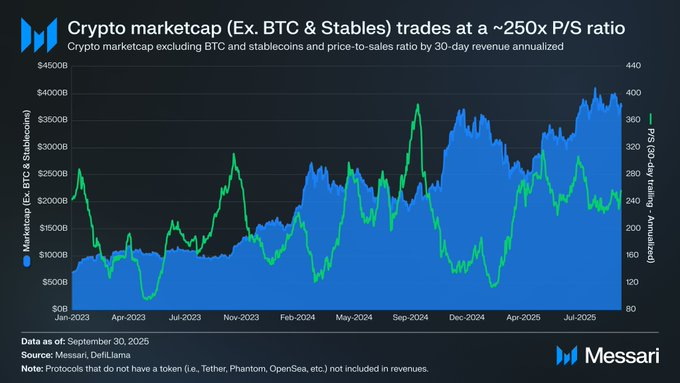
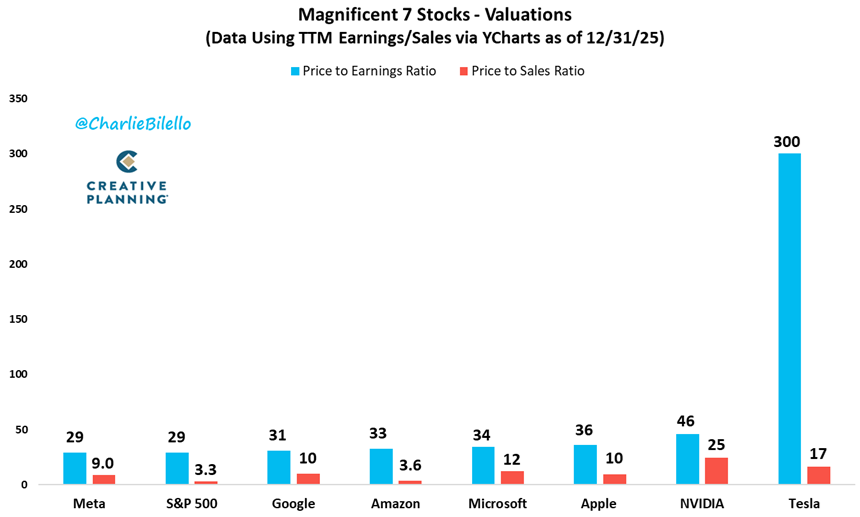
But despite this, valuations in crypto still remain high according to fundamentals. Looking at Ethereum and Solana, the two chains with largest Total Value Locked (TVL), Ethereum currently trades at a market cap of $373bn while Solana trades at a market cap of ~$80bn. Ethereum generated $2.8bn in revenue in 2024 and $812.742m in 2025, which seems at first glance to be quite strong. However, if we presume an average $1-2bn in average annual revenue, this implies a P/S ratio of 200-400x, with slowing growth and value leaking to Layer2s. For context, Nvidia, the holy grail of growth stocks, trades at a P/S ratio of 25x. Solana's outlook is more positive, but still problematic, with annual revenues of $1b+, implying a P/S ratio of 20-40x. Although this seems more comparable, the reason it is still problematic is the nature of crypto's users, which, of course, drive revenue.
Take OpenAI for example. Approximately 800 million people across the globe use ChatGPT per week, with each action creating a feedback and context loop that diminishes the likelihood of a user switching to a different model. These are sticky users. In crypto, a 'sticky' user does not exist, or at least has not thus far. Revenues are subject to, as Santiago Roel Santos puts it, hyper-cyclical, speculative flows - perps, memecoins, liquidations, MEV spikes, degenerate churn. The issue with the amount of speculation that occurs in crypto is the boom/bust phases which results in an eventual slow-bleed of users who leave the casino broke.
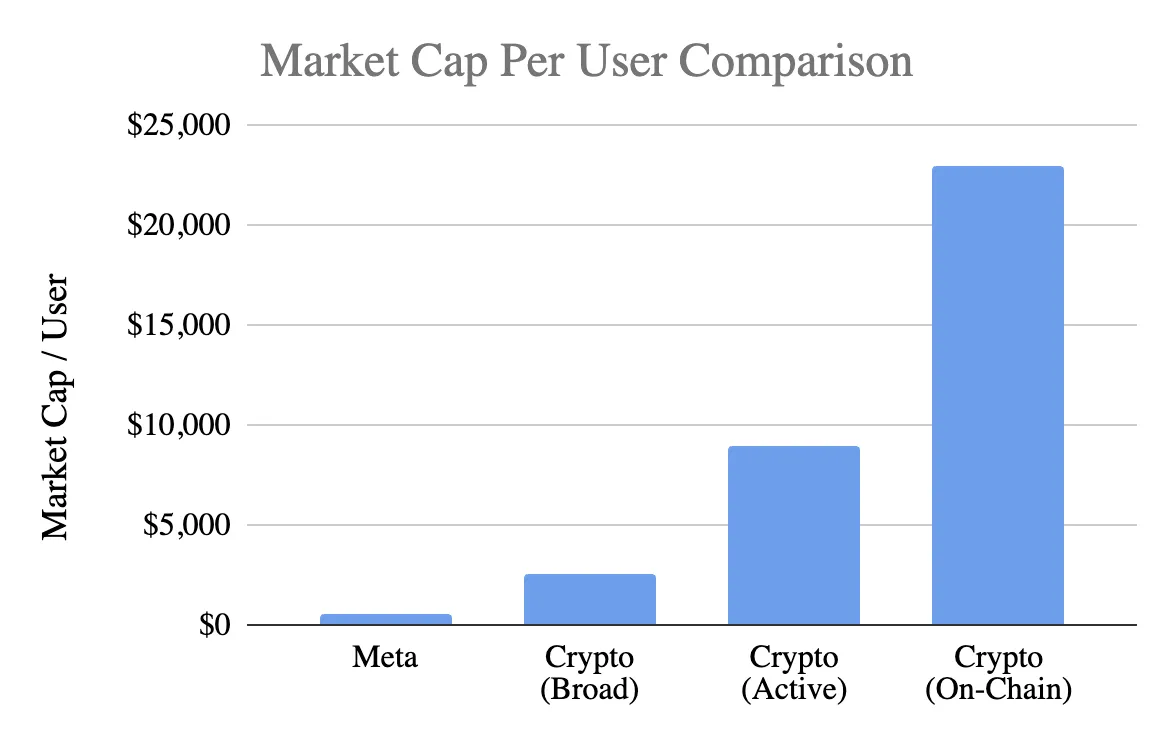
Sceptics would push back here, claiming that crypto tokens command a premium because of their 'network effects', also known as Metcalfe's law, which states that the value of a network is proportional to the square of the number of connected users. However, this crumbles under scrutiny. In traditional social networks like Meta's Instagram and Facebook, the product improves as the user base grows. In crypto, "negative network effects" often emerge: additional users cause congestion, spiking fees, and degraded performance. Because the underlying code is open-source and modular, no true competitive moat exists; liquidity is mercenary, and users rapidly churn to cheaper competitors the moment incentives dry up. The resulting valuation disconnect is stark. Meta, with its 3.1 billion users, trades at roughly $500 per user. Conversely, the crypto ecosystem, with approximately 40 million active on-chain users, is effectively priced at over $23,000 per user. Investors are paying a staggering 45x premium for users who are far less sticky, significantly harder to monetize, and prone to vanishing the moment the speculative music stops.
Contrary to what the uninformed reader may suspect here, after 1000 words of disdain (read: realism), I am in fact bullish on crypto in the long term. The technology is here to stay, and will revolutionise significant parts of the financial ecosystem, which remains heavily siloed, inefficient and gatekept. If you want the bullish long term vision, please read 'Internet Finance' by X user @TheiaResearch. It captures the extent of the opportunity and is extremely well written. With that being said, I do expect a significant rerating of the vast majority of crypto tokens, and I expect further alignment with the metrics used to value businesses and investments in 'traditional finance'.
This is not a bad thing. Just as forest fires clear away the decaying underbrush to return nutrients to the soil, a valuation reset is necessary to purge the industry of zombie chains and speculative vapourware, ultimately paving the way for maturity and clearing the canopy for the true winners to emerge.