Collector Crypt Primer
What is Collector Crypt (CC)?
"Fort Knox" for collectible cards. Users send their collectibles to secure vaults, where their authenticity is verified and authenticated. The card is then linked to the users wallet. Users can then trade, buy and sell cards from one central marketplace. CC currently only supports Pokemon card trading, but has the infrastructure available to expand into the rest of the TCG (Trading Card Game) market, valued at around $7.43bn, of which Pokemon is roughly 35-40%. CC was founded and launched in Jan 2025.
Moreover, CC improves upon a number of the current pain points in the TCG ecosystem (as illustrated in the table below).
| Pain Point | CC Solution |
|---|---|
| Fees - eBay has a monopoly over the TCG trading market, and therefore has the ability to charge exorbitant fees. For example, eBay charges sellers up to 12.9% on the first $7,500 and 2.35% thereafter. | Industry leading transaction fees of just 0.5% to 2.0%. |
| Fraud risk - if you buy a card from eBay, buyer has no idea whether it's real. Could pay thousands for a rare card and it turns out to be fake. | By having centralized vaults in 0% sales tax jurisdictions (saving end user $), where Collector Crypt verifiably proves authenticity, the issue of fraud is almost completely eliminated. |
| Fragmented and Illiquid Markets - liquidity exists across "catch-all" marketplaces like eBay as well as niche marketplaces which lack volume. | Collector Crypt acts as the sole intermediary for all TCG activity, concentrating liquidity with higher consumer confidence as a result of the above fraud improvements. Unlike eBay, it is purpose built for TCG trading, incentivizing users not only with lower fees/costs but also UX. |
| Slow Transaction Velocity - High fees mean a new owner may need to hold a collectible for 1-2 years just to break even | By tokenizing collectibles into NFTs, settlement is instant rather than taking a few weeks via existing solutions. A buyer can now own cards without ever holding them, with the right to redeem that NFT for the physical card whenever necessary. |
Gacha Mechanism
The table above describes the marketplace mechanism. Collector Crypt also has a "gacha" mechanism, which is a digital repack machine that offers a gamified pack-opening experience for trading cards. It is a reimagining of traditional physical packs whereby users buy a pack with the potential of yielding a $1000 card (or the more likely outcome of a ~$10 card). How it works:
- Collector Crypt maintains a portfolio of physical trading cards by buying in bulk from eBay and other marketplaces at 85-90% of market price due to their efficient sourcing - the founders are all avid TCG players and have the connections to facilitate such a discount. They are also one of eBay's largest card buyers, purchasing $500,000 worth of cards every week.
- Users pay a set amount e.g $50 and receive a random card from the machine based on pre-set probabilities. For instance, there might be an 80% chance to hit a common card and a 15% chance for a rarer one.
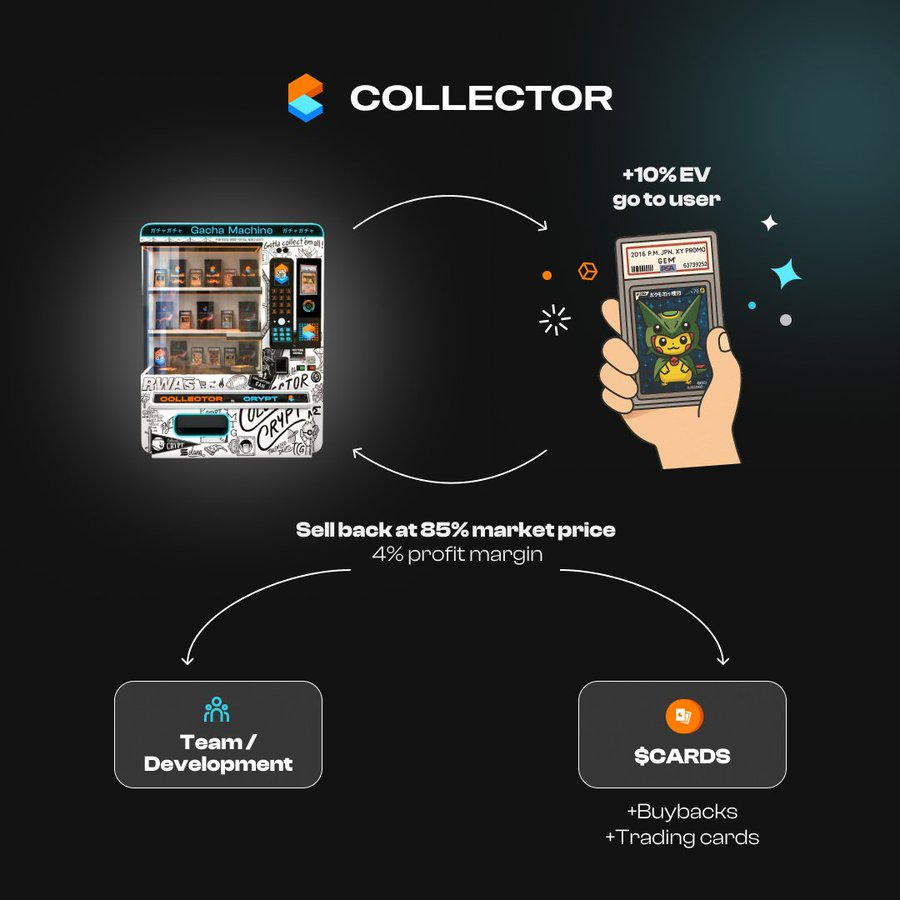
- Significantly, as well as the lower costs and fees associated with digital (vs physical) pack openings, CC's Gacha has a positive expected value for users. On average, if you put in $50, your EV is $55. This is enabled by their lower sourcing costs, as well as lower margins as illustrated in the diagram below.
CC Revenue
CC generates revenue in the following ways:
- Marketplace transaction fees (0.5-2% of sale value).
- Gacha revenue (4%) profit margin as denoted above.
Revenue statistics:
- Total Gross Revenue: $10,032,033
- August Gross Revenue: $2,818,005
- $23,347,043 Revenue (Gacha + Fees/Royalties) - $20,529,038 Expense (Buybacks)
- MoM Revenue Growth: 69%
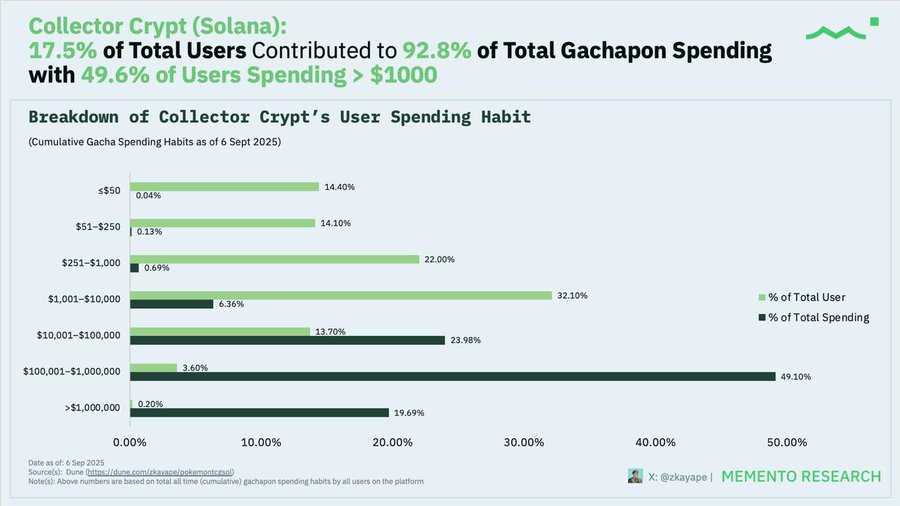
!Collector Crypt monthly revenue: gacha + fees (green) against buyback expense (orange), with net gross revenue in navy (Dune, @zkayape). - Revenue Breakdown by Product Offering - Net Gacha Revenue $8,592,068 (85.6%) - Marketplace Revenue $1,439,965 (14.4%) - Gacha specific stats: - Moving ~18k-20k packs/day at $50 each -> estimated around ~$900k-$1m daily revenue. Demand is far outweighing supply, creating frustrations among some users (bullish?) - 17% of total users contributed to 92.8% of gacha spending on CC; 49.6% of users spent >$1000. - Some CC estimates put net profit at ~10% of gross sales -> $85k-$100k/day profit. - Buybacks: - In CC, 95% of cards are sold back within 24h at an 85% discount to market value. - One-time sales yield ~1%, but recurring buy-sell loops create compounding 5% margins each cycle -> main flywheel for CC. - CC is therefore more an exchange or perpetual yield machine rather than merely a card seller. Trading flow is monetized continuously.
How Revenue accrues to $CARD:
- User flywheel - users earning and using $CARDS on platform creates latent demand. Fee unlocks is a key incentive to enable this demand. Data is not clear on this. Buybacks - counterpartytv
- 15% card spread will go back into token treasury
- Raydium fees back into token treasury
- Founder has expressed willingness for buybacks and for token to succeed.
Competition
| Feature/Metric | Collector Crypt | Courtyard | Phygitals |
|---|---|---|---|
| Core Product Offering | Gacha + Marketplace | Gacha + Marketplace | Gacha + Marketplace |
| Key Differentiator | Gacha is +EV. Has a token (only liquid exposure on the market to TCG). | Heavily venture-funded ($43M raised). Offers a wider range of TCG collectibles e.g baseball/basketball cards. | - |
| Gross Revenue (All Time) | $10,142,033 | $53,715,853 | $1,868,515 |
| Total Volume Transacted (All Time) | $154,668,366 | $422,851,667 | $14,282,974 |
| Funding | Raised <$3M to generate $10M in net revenue and over $150M in volume. | Raised $43M to generate $53M in revenue. | - |
What is the purpose of the token?
- Native rewards token - every transaction, trade and deposit earns users $CARD, ensuring those who use the platform are incentivized to stay. Also unlocks substantial fee discounts, premium features in the marketplace, rewards, governance rights.
- 0.5% fees are enabled by using $CARD
- CEO wants token to essentially act as an ETF for large funds to gain market exposure to pokemon + collectibles. Until now, for funds/institutional capital to get access to collectibles exposure (up 113% in 10 years), they would have had to acquire and manage a portfolio of physical cards - operational nightmare. $CARDS abstracts away the underlying physical complexity. Instead of dealing with thousands of individual physical assets, a fund can deploy capital into a single, liquid digital instrument whose value is tied to the performance of one of the largest platforms in the market. Thus far, $CARDS is making exposure to a highly illiquid market much more liquid.
- $CARDS has already seen interaction with a much wider base of participants other than just retard trench degens, such as realDannyNelson
Tokenomics
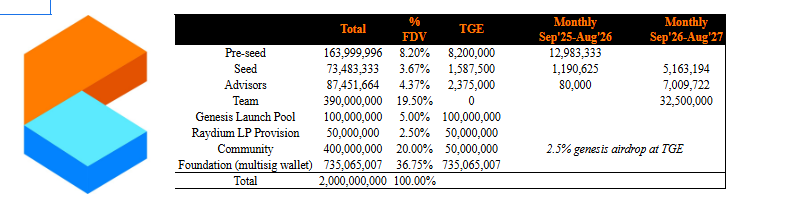
- Circ at TGE - 212,162,500 (TGE column, foundation funds are locked). This is 10.6% of FDV.
- Inflation Rate of 14,253,958 tokens per month starting from September until August 2026 (6.72%). Current supply is therefore 226,416,458 (11.3% of FDV).
- After August 2026, monthly supply increase is 44,672,916. Circulating supply at this point will be 427,882,912 (21.4% of FDV). The inflation rate at this point will be 10.44%.
TAM
- Pokemon card market $21B
- Pokemon is 30% of total TCG in 2024
My Thoughts
- Actually a good play. This is not a crypto business, this is a RWA collectibles business - indeed it is the second largest business in this space, and the only one that allows liquid exposure by virtue of the token. Has proven PMF and this current attention spurt will drive further actual Pokemon traders to the platform, thus increasing revenues.
- Real market cap is currently around $50M.
- Risks:
- Courtyard releasing token. However, CC team seems much more crypto native and platform seems much more gamified.